
The Profession of a 3D Artist in 2025: Shedding on Some Light
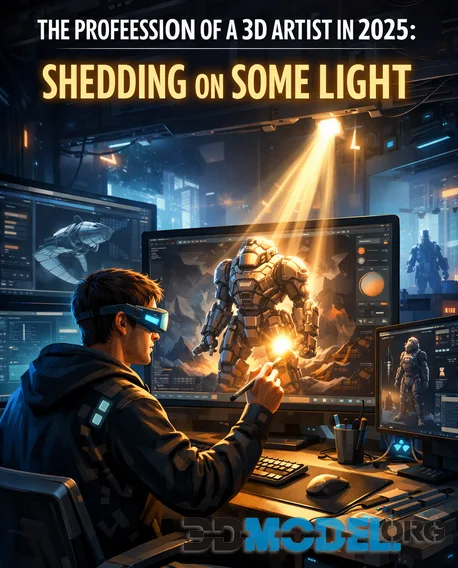
In the last few years, artificial intelligence has transformed the work of 3D artists: what once took days or even weeks, like, routine modeling, is now expedited.
Or even fully automated.
The thing is, ‘neurals’ can generate 3D objects from mere descriptions or images. And this not only lowers the barrier to entry, but also empowers artists to prioritize creativity. Consequently, all these shifts have altered industry demands: companies now increasingly seek designer’s adept at leveraging AI tools.
Regardless, let’s dissect the current state of the profession, examining essential skills, the extent of recent changes, and a few lurking challenges.
Oh, and any 3D designer will need assets. Like, obviously. On our site, you’ll find a wealth of them: creatures, animals, fictional characters, vehicle models, and far more - bookmark our website with 3D models. All free, no registration required.
So, What’s Different in 2025?
Many things.
Technical prowess alone no longer suffices, as the artistic intuition and process orchestration now reign supreme. Before, every detail demanded manual labor. And today, AI handles the grunt work: UV unwrapping, retopology-things, asset generation, even texturing. Algorithms execute tasks with unmatched speed and precision.
But what remains irreplaceable? Creative vision, that is.
Crafting cohesive scenes, evoking mood and style, mastering art direction – these define an in-demand specialist.
Moreover, fluency in modern tools and the ability to blend AI with traditional methods are critical. For instance, importing a Kaedim model, refining it in Blender, automating, and enhancing materials – via AI.
The more adept an artist is at weaving tech into nowadays workflows, the greater their value.
And yes, continuous learning is still non-negotiable. The field evolves relentlessly: new architectures emerge, software updates roll out. Like, top-tier designers are already navigating Omniverse, tinkering with generative models, and harnessing AI-driven lighting.
By the way, don't forget to visit our section with architectural 3D models - there you can download thousands of ready-to-use three-dimensional objects, houses, landscapes, entire exterior scenes, and much more for your projects.
Where to Study
That one’s really depends on the budget and how bad you want it. Like, in gaming and film-making, employers care more about actual skills than diplomas – you’ll need a solid portfolio or to nail a test assignment.
But there are a few ways to learn 3D modeling, each with its own pros and cons.
One route’s somewhat traditional. These mostly includes colleges. Another one’s fully online courses. They’re cheaper and great for beginners, as you get theory to study on your own. But there’s a ton of these courses, so do your homework – check the program, read reviews, or better yet, talk to past students.
And there’s also self-teaching: scouring free YouTube tutorials and guides – plenty of pros share their knowledge for free. This way’s basically no-cost, however, there are its catches: you’re on your own, and some older tutorials get outdated fast (thanks to software updates). Lastly, without strict deadlines, staying motivated’s a struggle.
You might need extra push to keep going.
Check all the options out and try to pick the best one for youself.
But… Is It Truly Worth It?
Oh yes.
Quality 3D models're still in great demand, and the market prices prove it. But you should always get to be real about your skill level. As for the future, AI’s going to make creating graphics (2D, UI, UX, you name it) way easier. That said, know modeling means you can pivot into other fields with no visible problems: it opens doors for growth and lets you flex those creative muscles.
Just do what you love, and the rest’ll follow.
Best of luck with everything. You got this.
Ctrl
Enter
Noticed a misTake
Highlight text and press Ctrl+EnterRelated news:


Comments (0)
Information
Users of Guests are not allowed to comment this publication.
Users of Guests are not allowed to comment this publication.